

|
| |
|
A new method of
rehabilitation helped 27 year old Petri: "The doctors didn't believe
I would survive - but soon I will ride a motorcycle again!" |
||
|
ANNU LIIKKANEN Four years ago 27 year old Petri Salo was severly injured in a motorcycle accident. He was unconscious in a hospital for several months and the doctors said to his parents that Petri would be a vegetable. But thanks to his fighting spirit and due to a new method of rehabilitation Petri is miraculously back on his feet. It's July 2nd 1998, a warm and beautiful summer day. The sun is shining and life smiles at 23 year old Petri from Haparanda, Sweden. He's looking forward to start training to become a securityguard in the autumn, but at the moment he is working as a taxidriver. And today he's going to test drive his friend's new motorcycle. Petri who has had his motorcycle driver's lisence since the age of 16, mounts the green Kawasaki and drives off. But he doesn't remember that anymore. Only 500 meters from his own home, Petri loses control of the motorcycle, crashes and is severly injured. Injured so severly that nobody believes that he will survive. Except his mother Hilkka. - He will, I said. And likewise when the doctors said that Petri will not wake up from the coma. He will, I said again, tells Hilkka when we meet in the home of the family in Haparanda. Almost four years have past since the accident and her son is very much alive.Thanks to the intensive training - and an even stronger power of will - Petri can walk and talk once again. Against all odds. - Nothing is impossible,
assures the Haparanda boy himself, with a wide smile and an intense look
in his blue eyes. On the contrary he can't remember anything about the
horrible accident in june 1998 or the time just before it happened. |
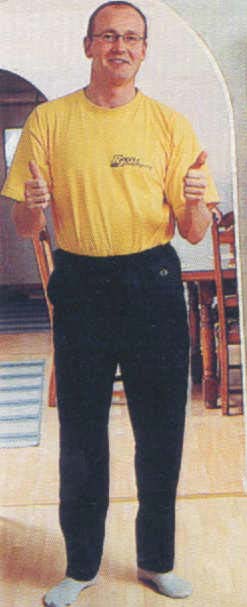 You can get better if you train |
|
|
- About half a year is missing from his memory. The last thing I remember before the accident is October 25th 1997 when somebody attempted to rob me at my work, Petri tells us when we sit down for a coffee in the kitchen. What he knows about the accident others have told him. - I saw two cars which where going to turn to the right, stepped on the gas and passed them. And then after that, when I started to break, the motorcycle started to wobble. Seconds after the tragedy was reality. The motocycle was in the ditch and Petri was flown-off from it and skidded along the hard asphalt surface of the road. An ambulance was called and Petri was taken to a hospital in Kalix, from where, after the doctors saw how severly he was injured, he was flown to a hospital in Umeå where they had a special ward. The worst injuries were to his head, even though he had worn a helmet. I got four brain heamorrhages,
the brainstem bursted and the right side of my body was paralyzed. - In the beginning I tried to sit up in my bed, but I didn't have any control of my body. And it is still often like that. My legs and upper part of my body feel like they are mine, but the middle part of my body feels like it's somebody elses, Petri who keeps on fighting clarifies. Slowly his condition improved. He was transferred to hospitals in Boden and Kalix and on October 23:rd he could go home. Although he couldn't either walk or talk specially well. I told the nurses that I will leave the hospital in a Rolls-Royce and so I did, remembers Petri and laughs happily. After a program on Finnish TV his hopes were really lit. It was about a woman who had been sitting in wheelchair for 20 years and who took her first steps. She was able to do so because of a new method of rehabilitation developed by a German doctor who has been studying the central nervous system for over 20 years. - It was the best TV program that I had ever seen, Petri admits and smiles. The method is based on intence training of easy movements. Four hours a day with lunch in between, from Monday to Friday. Petri decided to take his chances and on December 27th he flew to the main clinic, located in Benalmádena near Malaga in southern Spain. I sat in a wheelchair, but I took only a walker and crutches with me. On the following day after my arrival I started to train hard, determined to walk again! - I had to start from the beginning. First I had to learn how to creep and then crawl on all four. Like a kid. At this stage his determination became handy. - My hobby has been
track and field since the age of 13. During the years I have learned not
to give up at the first obstacle, says Petri, who likes to do extra training
in the mornings and evenings aswell, as well as to have extra training
days. But the therapy has
given results! After four weeks in Spain Petri managed to walk short distances
without crutches and after five months even longer distances outdoors.
When Petri's mother and father came to pick up Petri in May 2001 they
hardly believed their eyes. His speech is almost
normal and because his right arm doesn't obey him fully Petri has also
trained up his left arm. So now he can do things to his car in the garage. - It would be a lot
cheaper for the society if he could get so well that he could start working
again, says mother Hilkka, who is helping his son with complaints over
the decision of the Country Council. The family have contacted a lawyer
and are ready to turn to the European Union for help. Perhaps they don't
know of the rulings of the court in Luxembourg, that people can go to
another EU-country to get medical treatment, Hilkka says and spreads some
papers on the coffee table. For now Petri is using his training-bike at
home, swims and trains daily in a physiotheque and in the sportshall of
Haparanda. - If you train you can get better. Everything is possible, the 27-year old Petri Salo says with determination. A free translation
of an article that was published in the Swedish weekly magazine "Allers"
|
||
|
The slow journey
of Jukka Lehesaari from his accident onwards. |
||
|
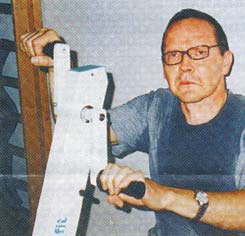
- I walked for the first time around the duckpond without a cane, at least 300 metres, says Jukka Lehesaari, proud of his achievement, under the Spanish spring sun. Jukka, who has worked at the Joined Congregations of Turku and Kaarina as a priest for students and international congregation, has become very familiar with a cane during the last year. "Don't fall in love with the aiding tools", said a friend to me at the clinic. Jukka decided to try how the walking, which has regained certainty from the treatment, was. It went well. I have
been using a cane in walking races, that I have had with Petri, but he
falls so easily, because his not using a cane. He has been training for
5 years. |
 |
|
|
Zero hours The hour zero in the life of Jukka was on September 13th 2001. He counts his life from the moment of the accident onwards and thinks back at the days that have past. He returns to that moment every day and from there he starts every morning. The phases of the accident have gone through in Jukka's mind hundreds of times like in a movie. On each detail a heavy question has come in to the mind: Why? "Recovering from brain stroke takes time. It takes patience", said a doctor in UHT after telling Jukka who was lying in bed, what the symptoms after the accident meant. "One day at a time", they said. - I have always loved sports; all kinds of: Crosscountry skiing, bicycling, running. And to work with my hands: building and stuff like that. In the hospital I realised that I was paralyzed. I couldn't do anymore what I had been able to do before. - It was hard for me to believe what had happened to me. I had experienced so many good things in my life, blessings. Why didn't God guard me? What use does He have for this kind of life? One of the first feelings
that I felt was that I'm going to be an outsider. I couldn't live the
life anymore the way I used to live it. Home, work, personal relationships
- they all went new. As weeks went by, a thought started to creep into
my mind: I might never regain my health. That possibility I had a hard
time to accept. It has been hard to admit this kind of change in life.
My believes are also in crisis. How they will become, time will tell. Surviving strategies - I pray a lot. My prayer has simplified. That I can become healthy. I'm also quite much just quiet and just am. I can touch my sick hand, look at it and say to it: you could already start to move. It has felt nice when friends have touched and prayed on my behalf. To have friends who are not afraid to touch a person with illnessis very important for me. That somebody wishes that God would give good health to another person. - I read the book of psalms from the bible. From I have found many promises from psalms. I kind of like float in water with support of God's promises; He will heal all my illnesses… God can help and heal.. People are important - People have been very important for me during my crisis. Those who visited me immediately during my first days in the hospital: my sons, my close ones, my friends. People have remembered me much. Once in a while one of my sisters, a relative from Virrat or a friend phone me even to here. - Now when after year and a half my sister says, that you voice starts to be like it was before, or someone sees more traits of the old Jukka in me, that surely does give hope. Yeah that, and the fellow sufferes that I have met here in the clinic and how they have progressed. We, the bunch here in the clinic, have a unique way of humor and way of supporting each other. For example we yell to each others: "They didn't build Rome in one day". - Of us clients three are from Finland and three are from Sweden a little boy is from Spain. The training - Here in Spain, in the clinic located near Malaga, I will be in Coordination Dynamic Therapy for 20 weeks. In the morning I exercise with a Finnish trainer for total of three hours. Walking on a treadmill and with an exercise bike. Then there are uprising exercises from the chair and walking exercises. Then comes the lunchbreak and a rest. In the afternoons another three hours of same kind of exercises. Must do lots of work! - But you progress
litle by little. The wheelchair got ditched in May 2002, in October the
same year To the question is God unfair, when he lets things like this to happen to people Jukka answers with a twinkle in his eye: - Lots of accidents happen every year. This is just a kind of statistical probability. Otherwise there would not be any point in this. Markku Ahlstrand Published by permission of the Finnish magazine Kirkko ja me. |
||
| The Clinic | |
| SPAIN | Tel. +34 626 88 1116 |
| Benal Beach | Fax +34 952 576 217 |
| Benalmádena (Malaga) | Email: info@codytherapy.net |